
Introduction
SAP Field Service and Asset Management (FSA) is a new cloud-based and mobile first solution designed to optimize field service operations and asset lifecycle management. It enables organizations to streamline scheduling, dispatching, planning, and asset maintenance workflows to improve operational efficiency. With the introduction of the new SAP FSA solution SAP is effectively consolidating and repackaging SAP Field Service Management (FSM) and SAP Asset Management for Resource Scheduling (the S/4HANA add-on RSH) with the roadmap for SAP RSH no longer active.
In today’s competitive landscape, our clients face increasing pressure to deliver exceptional field service experiences while maximizing asset utilization and minimizing operational costs. SAP FSA addresses these challenges by providing an integrated platform that connects field technicians, dispatchers, and asset managers in real-time, enabling data-driven decision-making.
This article explores the key capabilities, business value, and strategic considerations for organizations evaluating SAP FSA as part of their digital transformation journey.
Key Capabilities
SAP Field Service and Asset Management delivers a comprehensive suite of capabilities designed to modernize field service operations and asset lifecycle management:
Advanced and Autonomous scheduling and dispatching
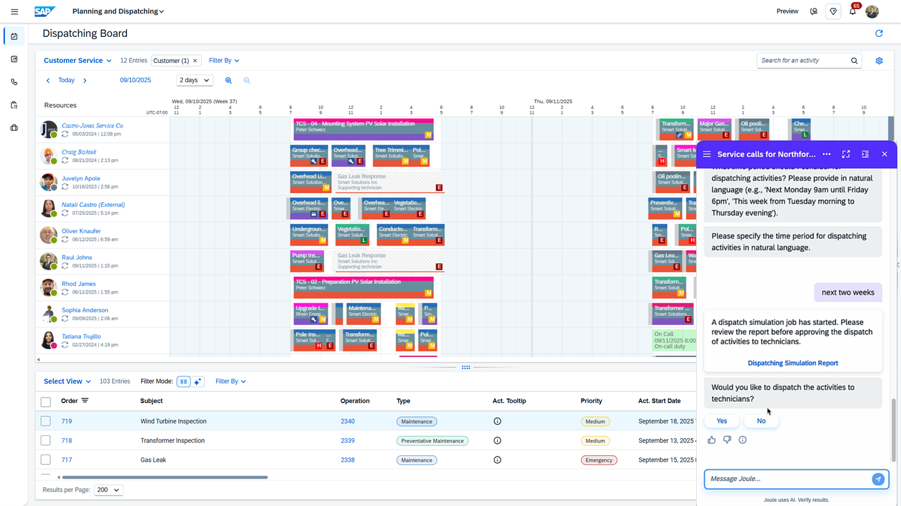
At the core of SAP FSA is a sophisticated planning engine that considers multiple variables including technician skills, location, availability, service level agreements and parts inventory. This intelligent scheduling capability ensures that the right technician with the right skills and parts arrives at the right time, maximizing first-time fix rates and customer satisfaction.
Mobile-First Architecture and Offline Execution
The mobile experience in SAP FSA is designed for the realities of field service work. Technicians can access work orders, customer information, asset history, and technical documentation directly from their mobile devices. The offline capability ensures that work continues uninterrupted even in remote locations, with automatic synchronization when connectivity is restored.
Asset Intelligence
SAP FSA provides comprehensive asset visibility, tracking equipment from installation through end-of-life. Organizations gain insights into asset performance, maintenance costs, and utilization patterns, enabling data-driven decisions about repairs, replacements, and capital investments.
Business Value
Organizations implementing SAP Field Service and Asset Management realize significant business value across multiple dimensions and business case is developed around:
Operational Excellence
-
Reduced field service costs through optimized scheduling and routing that minimize travel time and fuel consumption
-
Improved first-time fix rates through better asset data and maintenance history, ensuring technicians arrive prepared
-
Enhanced customer satisfaction via faster response times and more accurate service windows
-
Increased asset utilization and lifecycle value through proactive maintenance and performance monitoring
Strategic Advantages
Beyond operational improvements, SAP FSA delivers strategic benefits that position organizations for long-term success:
-
Real-time visibility into field operations and asset performance enables proactive management and rapid response to issues
-
Reduced unplanned downtime through predictive maintenance capabilities that identify potential failures before they occur
-
Improved workforce productivity by eliminating manual processes and providing technicians with the information they need at their fingertips
-
Enhanced compliance through automated documentation and audit trails for regulatory requirements
-
Data-driven insights that inform strategic decisions about service delivery models, resource allocation, and asset investments
Implementation Considerations
Successful SAP FSA implementations require careful planning and attention to several critical factors:
Data Migration and Master Data Management
Asset master data quality is foundational to SAP FSA success. Organizations must invest in cleansing and standardizing asset data before migration, establishing clear ownership and governance processes for ongoing data quality. This includes equipment hierarchies, maintenance histories, technical specifications, and location data.
Mobile Device Strategy
Defining the mobile device strategy early is essential. Organizations must decide between company-provided devices or bring-your-own-device (BYOD) approaches, considering factors such as security requirements, user preferences, and total cost of ownership. Connectivity requirements and offline scenarios must be thoroughly tested to ensure field technicians can work effectively in all environments.
Change Management and User Adoption
Field service transformation is as much about people as technology. Comprehensive change management programs that engage field technicians, dispatchers, and managers throughout the implementation journey are essential. This includes:
-
Early involvement of field personnel in design decisions
-
Clear communication about benefits and changes to daily workflows
-
Hands-on training with realistic scenarios
-
Ongoing support and feedback mechanisms
-
Recognition and celebration of early adopters and success stories

Strategic Outlook
SAP Field Service and Asset Management continues to evolve with emerging technologies and changing market demands. Organizations should consider FSA as part of a broader digital transformation strategy to modernize field service operations.
AI-Driven Capabilities
Artificial intelligence is increasingly embedded in SAP FSA, powering capabilities such as predictive maintenance that anticipates equipment failures, intelligent scheduling that learns from historical patterns, automated work order classification and routing, and natural language interfaces for technician interactions.
Advanced Analytics and Insights
Modern analytics capabilities provide unprecedented visibility into field service operations. Organizations can leverage embedded analytics for real-time operational dashboards, predictive analytics for demand forecasting and capacity planning, and prescriptive analytics that recommend optimal service strategies.
Enhanced Mobile Experiences
The mobile experience continues to advance with augmented reality for remote assistance and guided repairs, voice-activated interfaces for hands-free operation, integration with wearable devices for safety and efficiency, and enhanced offline capabilities for complex scenarios.
IoT and Connected Assets
The convergence of SAP FSA with Internet of Things (IoT) technologies enables new service models. Connected assets provide real-time performance data, triggering automated service requests and enabling condition-based maintenance strategies that optimize service timing and resource allocation.
Sustainability and Circular Economy
SAP FSA supports sustainability initiatives through optimized routing that reduces carbon emissions, extended asset lifecycles through proactive maintenance, improved parts management that minimizes waste, and comprehensive tracking for circular economy models.

Deloitte Perspective
SAP FSA is a compelling step forward: consolidating field service and maintenance scheduling into one AI-powered, ERP-connected execution layer in SAP BTP directly addresses the fragmentation of the various SAP solutions. For businesses whose service operations are largely customer-facing: dispatching technicians across many sites and customers, managing SLAs, and optimizing routing and skills FSA is a strong strategic fit, and its cloud-native, mobile-first heritage (from FSM) shows.
However, organizations should weigh one important nuance before assuming FSA is a like-for-like replacement for every scheduling need.
Internal maintenance scheduling deserves careful evaluation. The former SAP RSH add-on was purpose-built for in-house maintenance planning: tightly coupled to S/4HANA Plant Maintenance, oriented around work-center capacity analysis, capacity levelling, and graphical scheduling of PM orders for a planner sitting inside the plant. This is a fundamentally different problem from optimizing a mobile field workforce serving external customers. As FSA consolidates both worlds into a cloud-first execution layer, organizations with deep, complex internal maintenance operations should validate that FSA covers the specific capacity-planning and PM-integration depth they rely on today rather than assuming full parity.
In our experience, the risks to test for include:
-
Functional depth for internal PM. Confirm that FSA’s workload and capacity planning matches the granularity of dedicated in-house scheduling (e.g., detailed work-center utilization, capacity levelling, long-horizon maintenance planning). Several of these FSA capabilities are still marked as lab preview or beta in SAP’s own material and maturity should be assessed against your requirements, not the roadmap.
-
Cloud vs. on-premise fit. Organizations heavily invested in on-premise or private-cloud S/4HANA with tightly integrated PM processes should assess how a cloud-first FSA model integrates with, and adds latency or governance considerations to, their existing landscape since FSA is a BTP native solution.
-
Roadmap and licensing clarity. Because FSA consolidates two previously separate, separately licensed products, organizations should obtain clear guidance from SAP on lifecycle, support timelines, and migration paths for existing FSM and RSH investments before committing.
Our recommendation. Treat FSA as SAP’s clear strategic direction for unified service and asset execution and plan toward it. But scope the adoption around your dominant operating model. For service- and product-centric businesses, FSA is well aligned today. For asset-intensive organizations whose model relies on sophisticated internal maintenance scheduling, run a focused fit-gap assessment against the former RSH capabilities before committing, and stage the transition to protect maintenance continuity.
Conclusion
SAP Field Service and Asset Management brings advanced planning, mobile-first execution, and comprehensive asset intelligence together on one platform, enabling organizations to deliver exceptional service while optimizing cost and maximizing asset value. Success, however, demands more than technology: it requires attention to data quality, integration architecture, change management, and organizational readiness. Organizations that invest in these foundations and that scope adoption correctly against their own operating model will be best placed to turn FSA’s promise into durable operational advantage.
In the Netherlands we have a team dedicated to designing and implementing SAP EAM solution for our clients. Are you planning to move to S/4 HANA Public Cloud or want to upgrade your (EAM) landscape further with new SAP EAM solutions?