




A phone call at 05:45 It is fifteen minutes before the first shift when a production operator calls in sick. On paper that is one absence. On the shop floor it can mean that a line cannot start on time, or that a machine would run without a qualified person. Today the response is a scramble. A shift leader checks who can step in, a planner looks up which production orders run on that line, purchasing braces for inbound components backing up on the dock if the line halts and supervisors rush to evaluate immediate production bottlenecks before customer delivery dates slip. Every answer sits in a different SAP module. By the time the picture is complete, the line start has passed. With labor shortages and fluctuating demand, this kind of disruption is routine rather than exceptional. Therefore, we will answer the question of how can an SAP landscape connects the right information and people quickly enough with AI to keep production moving and customer commitments on track?
One absence, several production orders at risk
A missing operator reduces capacity on a production line, and that delays specific production orders. Delayed production orders affect sales order delivery dates, impacts warehouse space and can force changes to labor plans. To see that chain early, a team needs two things in one place:
-
Production orders scheduled on the affected line, with their times and priorities work center, machine health and inspection data showing the current state of the line
-
Staff availability and qualifications, to find who can take over the sales orders, purchase orders and labor plans attached to those orders
The same logic applies to other disruptions: a production line breakdown, process variance or inspection scores that start to drift. The trigger changes, but the question stays the same. What is the impact, and what are our options?
The SAP foundation: the data already exists
Everything needed to answer that question already lives in the SAP landscape. The challenge is that shift supervisors must react within minutes to reallocate, push, or pull production orders. Yet the vital operational data needed to make those decisions sits fragmented across separate modules.
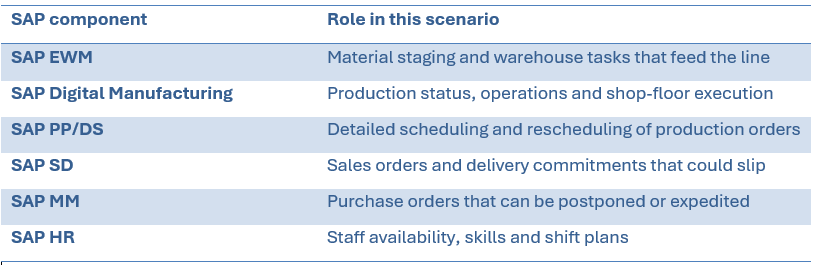
On top of this foundation sits a custom AI layer that connects to these modules through APIs. It reads from them, reasons across them and writes back only the relevant changes what an end user with the relevant authorization has approved. SAP describes the same direction for its Joule Agents: agents with process expertise that execute multistep tasks across SAP and non-SAP systems, with oversight and traceability built in. Our approach follows that pattern, tailored to the client’s own processes and data.
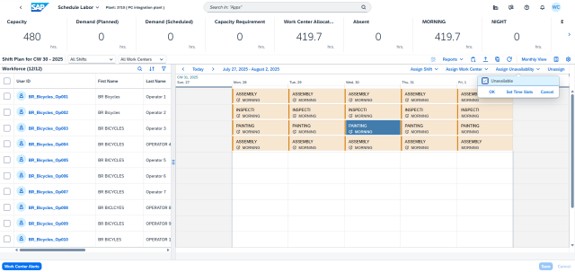
Figure 1: Process of calling a skilled worker sick in SAP Digital Manufacturing
Moving from scramble to a 360° analysis, the AI layer continuously interprets machine health data, production order times, and quality inspection results so that breakdowns, process variances or operator absences are flagged early. Instead of leaving planners to chase down information across disconnected systems, it synthesizes cross-module impacts, mirroring capabilities like SAP’s Manufacturing Assistant through real-time disruption monitoring, material staging and inventory impact orchestration, and next-best-action recommendations weighed by their pros and cons. In this use case, the comprehensive analysis pinpoints production orders on the affected line that require rescheduling. In addition, it identifies which sales orders and customers will experience delays, and flags purchase orders to place on hold to avoid warehouse overload, all while outlining necessary labor plan adjustments and surfacing qualified in-house operators ready to take over. The production planner might then as a simple question: Operator [name] on line [x] is absent from tomorrow’s early shift. Which production orders are at risk and what are our options?
Once a disruption is detected, the proposed AI agent would identify the production orders affected and trace their links to relevant purchase and sales orders. These SAP views illustrate the documents it could bring together, giving planners a starting point overview to assess the impact across production, purchasing and customer deliveries which ultimately make decision making more accurate and easier. The following screenshots illustrate the intended workflow showing how an AI agent could made those selections automatically.
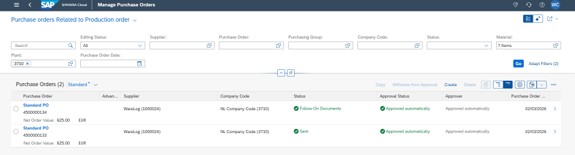
Figure 2: Purchase order modification screen accessible to an AI agent
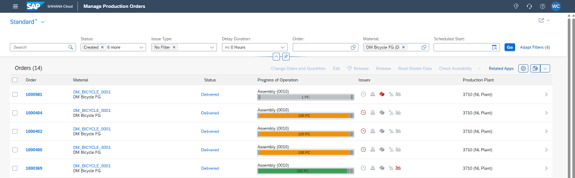
Figure 3: Affected production order modification based on the missing worker
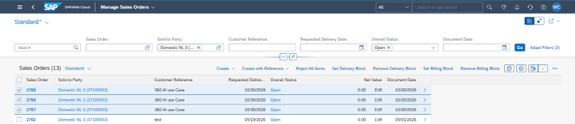
Figure 4: Affected sales order modification based on the missing worker
The attainable impact of AI on business decisions
Designed to benefit production planners, sales, purchasing, HR, and shift leads on the line, this system aims to identify production problems early, respond faster, and coordinate an integrated response across the supply chain. The required next steps vary dynamically depending on live sensor data, order times, inspection results, and machine health, alongside standard documentation such as purchase orders & production orders. While the agent guides the analytical process and proposes follow-up actions, human judgment remains essential because a person makes the final decisions. Ultimately, its value lies in prevention, as avoiding a large production disruption saves far more effort than the analysis itself costs.
The decision stays with people, the AI layer does not decide. It guides the analysis, proposes follow-up actions and explains the trade-offs, and the production planner and shift leads always have the final decision.
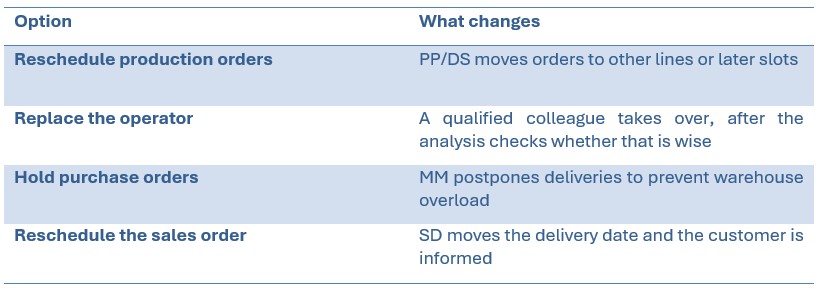
Outcome: The next day at 06:00, the issue is resolved
This matches the “agent plus human” model SAP describes for the planner of the future: the system recommends and simulates, while people focus on judgment and coordination. Once an approved response is in place, the coordination layer executes the follow-through across enterprise systems: it reschedules production orders in PP/DS, updates line assignments, and adjusts labor plans and operator shifts in HR. Simultaneously, it places agreed-upon purchase orders on hold in MM, updates sales order delivery dates in SD while alerting customer-facing teams, and monitors SAP Digital Manufacturing to ensure the line begins operations as planned. Therefore, the autonomous enterprise coordinated the gap in production, filling the absence with a skilled worker, and restructured the planning based on the disruption. Our disruption is now resolved with a temporary fix until the sick worker comes back.
Physical execution may follow later. For example, leading global automotive suppliers are already piloting humanoid robots to stage materials at the line and confirm movements directly back into SAP, demonstrating higher throughput and fewer handling errors in the production process. The possibilities are supported by the SAP landscape, we just have to put it into execution.
It is worth being candid about maturity. SAP’s own view is that today’s value comes mainly from specialized agents within a domain, while fully connected cross-functional agents remain an ambition. Data quality, integration and human verification decide success. That is why we treat the cross-module flow as a capability to design and validate with each client.
How Deloitte helps
The technology is only part of the work. We help manufacturers design and connect the workflows, data and decision points across warehouse and production:
-
Assess which disruptions matter most and whether the data behind them is trustworthy
-
Design the AI layer and its integration with EWM, Digital Manufacturing, PP/DS, SD, MM, HR
-
Embed approval steps, permissions and traceability, so people stay in control
-
Improve the use case step by step, starting with one scenario and one plant
A local staffing gap becomes manageable when its production impact is visible early and teams can act on it together. The next time someone calls in sick at 05:45, the first question should be which option is best, not who has the data.
Do you need help with the options to move to S/4 HANA or want to upgrade your (production) landscape further with new solution? Contact us through our official channels to evaluate modernization opportunities and define a successful S/4HANA transformation roadmap.