





Executive summary
Organizations implementing SAP S/4HANA face a critical, hidden bottleneck: knowledge fragmentation. While expertise is generated throughout an implementation, spanning architecture diagrams, configuration guides, lessons learned, and operational procedures, it routinely ends up siloed across inaccessible repositories.
This leads to a hidden delivery cost, extended timelines, inconsistent best practices, and knowledge loss during workforce transitions, a challenge especially acute for complex multi-site operations across all industries.
SAP Build Work Zone Advanced solves this by consolidating knowledge into a unified, searchable, SAP-native platform that accelerates decision-making, ensures consistency, and builds organizational memory. This article presents the business case for Work Zone wikis and outlines how Deloitte helps organizations maximize their S/4HANA investments through structured knowledge management.
The situation: knowledge fragmentation in SAP S/4HANA implementations
Imagine two SAP S/4HANA implementations, running in parallel
On the first project, development guidance lives everywhere and nowhere. A governance framework sits in a SharePoint folder. Integration patterns are scattered across PowerPoint decks on shared drives. Configuration best practices are buried in email threads. When a developer needs standard guidance, they search. They find multiple versions, with no way to tell which one is current, approved, or valid. So, they ask a colleague, who asks another, who relies on memory from a project three years ago. The guidance exists, but finding it costs valuable time and trusting it takes detective work.
On the second project, something is entirely different. Development guidance lives in a single, centralized wiki. When a developer needs the standard for non-SAP integrations, they search, find the approved version immediately, and move forward with confidence. When a functional consultant aligns with the development team, they reference the wiki. When a new joiner onboarding begins, they do not have to ask around.
The difference between these two projects is not budget, complexity, or team capability
It comes down to a single choice: treating development guidance as scattered artifacts versus a strategic asset. Every SAP S/4HANA implementation generates valuable knowledge from solution designs and system configurations to lessons learned. Yet across industries, the pattern repeats: the problem is not lack of knowledge, but a lack of accessibility.
The problem: the hidden cost of knowledge fragmentation
Knowledge fragmentation creates three interconnected problems:
-
Rediscovery instead of reuse: Development teams spend time solving problems that have already been solved. Teams draft governance frameworks from scratch, recreate existing solution designs, and troubleshoot recurring technical issues, all because past knowledge is hidden, not missing.
-
Inconsistent application of best practices: Without a single source of truth, teams apply standards sporadically. One stream follows established governance; another reinvents it. One team uses a proven integration pattern; another builds a custom workaround. The result is a fragmented S/4HANA architecture that inflates long-term support and maintenance costs.
-
Knowledge loss during transitions: When key consultants, leads, or internal staff transition off the project, their expertise leaves with them. Organizations don’t just lose headcount; they lose institutional memory.
The impact: quantifying the cost of fragmentation
Unaddressed fragmentation creates direct financial and operational drag across four areas:
-
Implementation delays and extended timelines: When teams cannot access proven solutions, implementation timelines extend
-
Rework and configuration inefficiencies: Without access to proven configuration approaches, teams make suboptimal design decisions. These decisions are caught late during Integration Testing or post go-live, requiring rework
-
User adoption and training inefficiencies: New users cannot easily access standardized procedures, best practices, or troubleshooting guides, leading to longer time-to-proficiency and higher support costs.
-
Risk and compliance exposure: Knowledge fragmentation creates compliance risks. Governance decisions, audit trails, and regulatory mappings may not be consistently applied
The solution: SAP Work Zone Advanced for Wikis
SAP Work Zone Advanced is not simply another collaboration tool. It is an SAP-native digital experience platform designed to seamlessly unite content, business processes, and project team in one unified environment.
Rather than working across disconnected systems, project teams interact with a live, integrated hub that brings day-to-day operations and knowledge together:
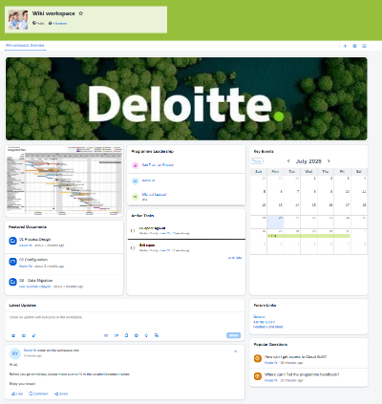
Figure 1: SAP Work Zone Advanced Wiki Workspace Overview
By embedding wikis within SAP Work Zone Advanced, organizations can address critical implementation needs across seven key pillars:
- Establish a single source of truth
Instead of scattering files across disconnected repositories, all project data is consolidated into a unified platform. Critical governance models, design patterns, and configuration settings become reusable assets rather than isolated, easily lost files
- Align knowledge with the SAP ecosystem
Unlike standalone tools like Confluence or SharePoint, SAP Work Zone Advanced operates natively within your SAP landscape. Documentation is accessible in the same environment where solutions are designed, built, and operated, eliminating system context-switching:
-
Developers access pre-approved integration patterns directly alongside their development tools
-
Functional consultants reference configuration steps without leaving their SAP workspace
-
End-users access standardized troubleshooting guides within the platform they use daily
- Standardize with flexibility
Wikis provide a structured yet adaptable format to serve as the project’s central registry, maintaining consistency while accommodating local business needs across five core domains:
-
Architecture Principles: Core design decisions and their technical rationale
-
Configuration Approaches: Step-by-step guides for configuring modules and processes
-
Project Governance Frameworks: Templates, approval workflows, and decision-making processes
-
Operational Procedures: Standardized processes for running the system post-go-live
-
Integration Patterns: Proven approaches for connecting SAP and non-SAP systems
- Accelerate delivery and reduce rework
When project documentation is completely transparent and searchable, implementation teams execute faster and with greater precision:
-
Accelerate design decisions: Teams rely on pre-validated patterns instead of debating established technological approaches
-
Eliminate duplication of effort: Custom developments are built once and deployed across multiple rollouts.
-
Apply proven solutions with confidence: Teams know they are following approaches that have succeeded in similar contexts
Result: every completed project becomes a foundational building block for the next
- Enhance organizational memory
Wikis ensure that knowledge persists beyond individual team members. Expertise is captured, refined, and continuously improved, transforming personal experience into institutional intelligence. When key contributors transition or retire, their valuable insight remains behind.
- Ensure complete auditability and version control
Unlike traditional file repositories where teams often rely on error-prone, manual naming conventions (e.g., _v2, _v3, _FINAL), SAP Work Zone Advanced offers seamless, native version history directly on every wiki page.
-
Guaranteed source of truth: Every edit automatically creates a tracked revision, ensuring team members always view the most up-to-date page without searching through duplicate files.
-
Complete revision history: Teams can view past iterations, track who made changes and when, and compare changes across iterations.
-
Instant rollback: If an unintended edit or outdated approach is published, administrators and authors can instantly revert to any previous page version with a single click.
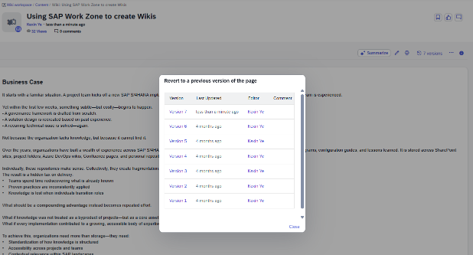
Figure 2: SAP Work Zone Advanced Wiki Page Versioning
- Maintain granular access control
To safeguard content integrity, SAP Work Zone Advanced enables content owners and workspace administrators to configure precise permission levels right before publishing or anytime later via the content list:
-
Full: Users can view, copy, edit, delete, move, or rename content.
-
Limited: Users can only view and copy content, preventing unwanted edits.
-
Hidden / Read-Only: Keeps drafts visible only to the creator and workspace admin, or restricts documents to viewing only.
SAP Work Zone Advanced vs. alternative approaches
Organizations often consider multiple platforms for knowledge management. The following comparison illustrates why SAP Work Zone Advanced is the optimal choice for SAP S/4HANA environments:
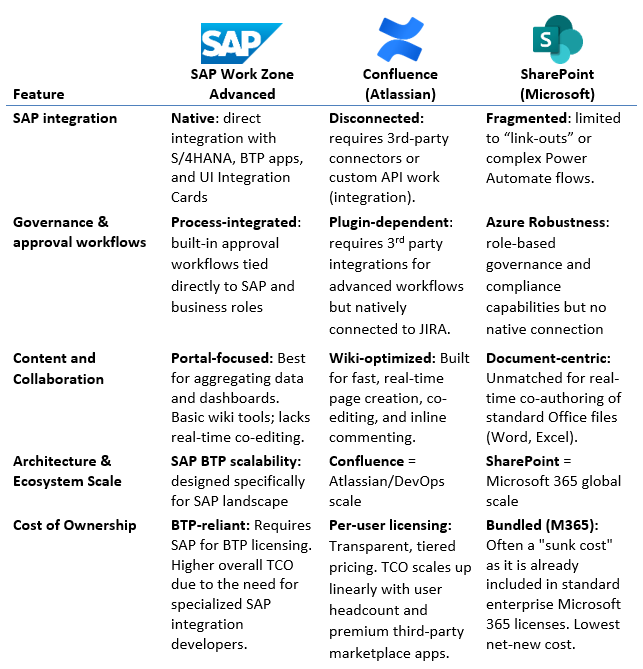
For organizations implementing SAP S/4HANA, the choice is clear: SAP Work Zone Advanced provides the integration, governance, and user experience required to make knowledge management a strategic advantage rather than an administrative burden.
Looking ahead: grounding enterprise AI with Joule and AI Agents
As AI capabilities rapidly evolve across the SAP ecosystem, the strategic value of creating a central SAP Work Zone Advanced workspace becomes even clearer. Looking ahead, we see potential in exploring how these wikis can be used for the Document Grounding Process. There is an opportunity for SAP Joule and other LLMs to draw directly from this grounded knowledge to deliver context-aware, tailored support across different client environments. By leveraging Cloud Foundry APIs and SAP AI Core, SAP business AI systems can seamlessly access all wiki content.
About Deloitte
Deloitte brings deep, multi-industry expertise to complex SAP S/4HANA implementations, across energy, manufacturing, chemicals, utilities, and beyond. Integrating strategy, delivery, change management, and continuous optimization, Deloitte empowers organizations to transform their SAP investments into competitive advantages. By embedding structured knowledge management as a core delivery capability rather than an afterthought, Deloitte helps clients accelerate implementation timelines, enforce governance, and build lasting institutional memory that compounds value over time.