



Highlights from releases: 2025 FPS0, 2025 FPS01 & Cloud 202602
Some time ago, SAP has switched to larger releases for Private Cloud (bi-yearly) such as the 2023 upgrade and 2025 which are individually followed by Feature Pack Stacks (FPS) and Service Packs (SP). The Public Cloud follows a different path with semi-annual releases in August and February. This article highlights a number of updates in the Enterprise Asset Management (EAM) space for Private and Public Cloud.
Private cloud S/4 HANA 2025 FPS01EAM highlights
The Perform Maintenance Jobs app (F5104A) enables maintenance technicians to efficiently execute, confirm, and document maintenance tasks directly on-site. It provides a user-friendly interface to manage operations, record time, and handle materials, ensuring accurate and timely job completion.
Enhanced with several modern capabilities, the app now supports seamless workflows in dynamic environments. Technicians can quickly capture unplanned material movements using integrated barcode scanning, reducing manual effort and errors. The scanning functionality solves the challenge where data entry is required in the system before taking the material. A technician is now able to quickly collect unplanned material and move on to perform the job without additional administration. A new calendar view offers clear visibility of job assignments, enhanced by intuitive color-coding and support for overlapping operations. This functionality support our clients in creating a user-friendly calendar view (somewhat like the Maintenance Scheduling Board) and easily jump to time confirmation based on their daily agenda of operations.
Safety and collaboration aspects have also been strengthened. Work permits are now directly visible within the app, ensuring compliance during execution. A new Work Permit tab has been added to the app and shows more details on the status of permits including color indicators of the status. This enhances efficiency and safety by providing users a way to quickly gain insight in the preparation for the job. Before this update it was required to check in different screen what the status was. Different clients, for example in the Utilities industry, are already implementing this functionality as permits are a core part of their processes.
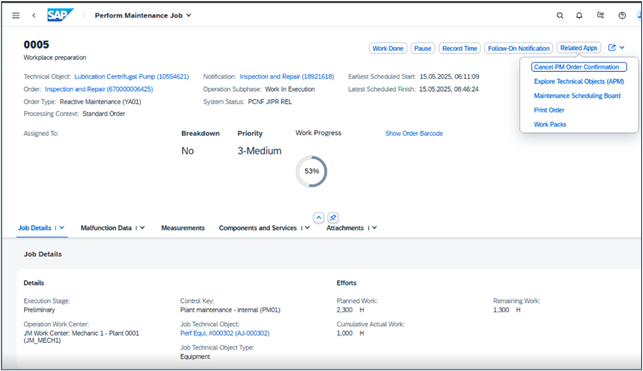
Perform maintenance job app
Manage inspection Checklists app (F6607)
The app F6607 Manage Inspection Checklists app is used to create, assign, and execute inspection checklists within maintenance and service processes. It helps ensure that tasks are performed consistently and according to defined standards, supporting technicians in capturing results, documenting findings, and confirming completion directly in the system.
With recent enhancements, the app goes beyond traditional technical-object-based inspections by enabling checklist creation based on materials in a maintenance order (even when no technical object master record exists). This allows inspections for single or multiple material components, including both serialized and non-serialized items, which is useful for scenarios that include spare parts validation, advanced execution scenarios, and refurbishment processes. The introduction of flexible checklist indicators and the ability to handle quantities of materials removes previous limitations and adds clustering capabilities for serial number–based inspections.
Resource scheduling
The SAP add-on for resource scheduling in S/4HANA helps maintenance planners analyze workload and capacity, build and simulate schedules, and assign the right people to maintenance operations. It provides visibility into current and future work, enabling better resource utilization, balanced workloads, and reduced asset downtime.
A key highlight is the integration of Joule as a copilot within the scheduling apps. This enables users to navigate the system conversationally, quickly access relevant planning tools, and retrieve contextual information without manually searching through the SAP Fiori launchpad. As a result, planners can make faster, more informed decisions in dynamic maintenance environments. As AI is a becoming a larger topic in EAM as well, using it in complex planning scenarios is a welcome functionality is dynamic environments where a lot of unplanned work occurs.
In addition, Resource Scheduling now supports billable maintenance orders from the Service with Advanced Execution process. This integration allows service-related data—such as service orders, items, and products—to be used directly in filters and displayed in the apps, improving alignment between maintenance planning and service execution. In different client projects the use of the Advanced Execution scenario is becoming a part of the core processes. Being able to add related orders in the overall planning schedule make the maintenance planning schedule whole again.
Finally, greater flexibility is introduced in team management. Team members can now be assigned to multiple teams, and system behavior can be configured to issue a warning instead of an error when this occurs. This makes it easier to manage shared resources across teams without unnecessary restrictions.
Tip: If case you use the schedules with automated planning functionality, check out the different BADIs that allow for customizing the automated planning algorithm. One of them allows great flexibility by allowing for an own custom algorithm.
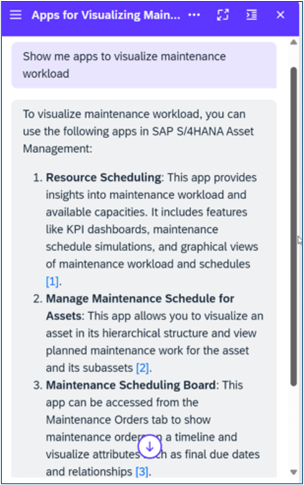
Joule AI for Resource Scheduling apps
Public cloud S/4 HANA 2602 EAM highlights
The Public Cloud update has brought significant new functionality for EAM. The highlights below show a clear focus on newly integrated functionality to enhance business processes within the standard.
Asset overview app
The new Asset Overview Fiori app, introduced in the 2602 release, provides a single, centralized interface for exploring and managing enterprise assets. Instead of navigating across multiple screens, users can access the full asset structure—combining functional locations and equipment—in one unified, easy-to-navigate hierarchy. The new app greatly enhances the ability to manage asset structures and is already being implemented at our clients or actively used in demos due to its consolidative nature.
The app allows maintenance professionals to quickly search for assets, visualize their position within the overall structure, and view detailed information in a side panel without leaving the main screen. It brings together both master data (like manufacturer details and warranty status) and transactional data (such as open notifications and maintenance orders), giving a complete picture of each asset in context.
Beyond visibility, the app also supports different action such as creating maintenance notifications directly from the asset view, either through a quick form or by using Joule, SAP’s AI copilot, via natural language. Overall, the app is designed to streamline asset navigation, improve data access and enable faster maintenance decisions from a single place.
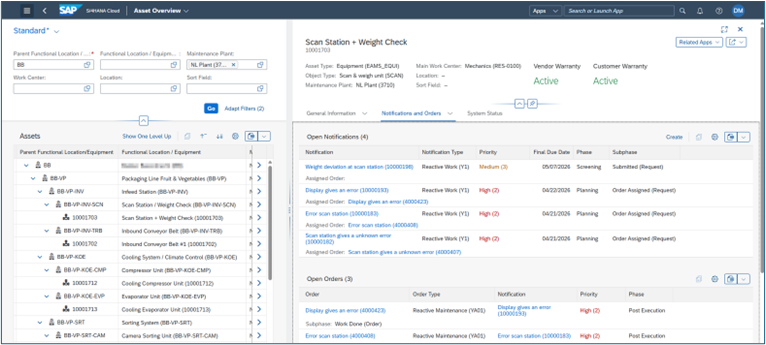
Example view of the new Asset Overview app
New scope item: Permit to Work (7Z4)
The Permit to Work scope item (7Z4), introduced in the 2602 release, delivers a standardized and controlled process for managing permits required for high-risk maintenance activities. It acts as a formal authorization framework that ensures maintenance work is carried out safely, in compliance with regulations, and with full alignment between maintenance, operations, and safety teams. It is initially available for Germany and the US but SAP targets to have it available for all standard countries in the 2608 update.
The solution is built around dedicated apps Manage Work Permit Template (F4692) and Manage Work Permits (F6579) for creating reusable permit templates and managing the full lifecycle of individual permits—from initiation and approval to execution and closure. Permits can be linked directly to maintenance orders and tailored to specific scenarios.
In practice, this enables organizations to clearly define safety requirements, enforce consistent procedures, and maintain full transparency over who worked on each permit. The result is improved safety, reduced operational risk which is particularly interesting for high-risk industries like manufacturing, oil and gas & mining. Clients have dealt with this process in different ways and are now able to start using a fully embedded solution. From an EAM perspective it brings an uniform way of working without getting creative.
At last, there are more apps that have received impactful updates such as Manage maintenance notification app which has received a larger update including situation handling, reference order tracking and adding Joule AI copilot.
Upgrading and evolving your landscape
As maintenance processes continue to evolve, we are committed to helping you stay ahead with the right tools and guidance. Whether you are exploring new capabilities or planning your next steps, we are ready to support you in designing and enabling a more efficient and intelligent maintenance landscape. SAP will continue with bi-yearly releases which means continuously adding new features that could bring processes back to standard or enhance the way of working. In the Netherlands we have a large team dedicated to design and implement core EAM solutions, including all additional cloud products to unlock all EAM value. Do you need help with the options to move to S/4 HANA or want to upgrade your (EAM) landscape further with new solution? Contact us through our official channels to evaluate modernization opportunities and define a successful S/4HANA transformation roadmap.